|
There are many ways to react when we are in front of a painting.
In front of the "Gioconda" by Leonardo we are astonished and incredulous.
If we look at Grunewald, terrified by the length of the thorns and
frightened by the audacity of the first authentic painted martyrdom.
What reactions do we have looking at a painting by the American,
Joseph Sheppard? Amazement. Because his skill arouses admiration.
He is almost excessively skilled, hence... wonder and perplexity. |
|||
|
I remember seeing, in the '40's in Italy, the work of Gregorio Sciltian, loved and admired even by Giorgio de Chirico for the perfection with which he reproduced in painting, the truth of a face or of those details, fingernails, hands, eyes: without forgetting the famous "expression" which, in those years, represented the inner truth very much requested by those sitting or buying a painting. What is new is that Sheppard belongs to this school, and gives you the certainty that the person portrayed is actually that, and physically true: to which he adds, when he feels like it, the unpredictable ironical variation of the "heroicalness or impudence of our time". This exhibition commemorating his 50 years of work reminds us of these antique masters, but seen through his personal narration. |
||
|
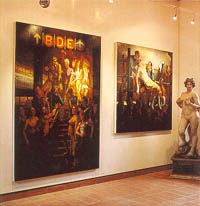
Sheppard displays twenty large paintings, twenty large drawings, twelve portraits of Pietrasanta craftsmen, an homage which has never before been dedicated to their skill, to close with fifteen sculptures. Who are the protagonists of his sensational skill? To tell the truth, looking at his inventions I feel thrown out of my time, because I have been accustomed, for years, to write on the loved contemporary: Alberto Giacometti, Bacon, Balthus, de Chirico. The art of Joseph Sheppard takes me back a lifetime, as if the time of school readings or the reproductions of the ancient art masterpieces were about to reemerge. Their memory is here. And the painting, the drawing, and the sculpture of this American make me believe in the existence of this way of working: his. It captures me through persuasion. The people we meet in bars, supermarkets, in big cities, in sport centers at the end of a boxing fight, are his subjects: they are so real and recognizable with our time, to the point we exclaim: "but I've just seen these guys". His "Icarus" which I want to take as an example of a classical spirit close to us, in fact has the face of a teenager who could be walking around wearing a T-shirt and jeans. The same aspect applies to the "Two Girls" or to the terrific gang of hoods wearing dark glasses in the "Provincetown Bar" which seems taken from a shot of a popular movie. Am I paying a compliment to the challenge of his way of working? Or is it my certainty that his theatre is necessary in order to keep afloat, astonished or incapable of finding another solution that can match his? I asked about Sheppard in Pietrasanta, a city of foreign artists and craftsmen unique in the world for their skill. Everybody knows him, him and his life. And I want to repeat my admiration for the homage he pays in the paintings dedicated to the famous Pietrasanta craftsmen: I will mention only the one which he made of one of the most famous, Enzo Pasquini: "terrific" as you say in America for the skill in treating the marble of the Apuane mountains as a kin, a close relative. In the bust "Woman with Flowers in her hair" I recognize that Sheppard's hand is at home in Pietrasanta. The air is there, no doubt about it. It's enough to leave you breathless, because all the subjects that are in a Sheppard character, have the identity card of truth: they are our contemporaries invented by. nature, but painted by Sheppard. The beauty of his paintings is the sum total of beauties. And Sheppard, a devil of our time, with the face of a popular actor, has not backed out from this confrontation that makes him range, as if the entire figurative system had burst open, when he portrays the boys under the shower as well as when he paints the American "rock & roll", or the beautiful nude girl with a sheet. Sheppard seems to have a kinship with the other world: antiquity presses him, but seen with eyes of the year 2000. His is a battle won by a virtuoso who entertains us with anything he wants. I am tempted to believe in anything he invents. Giorgio Soavi |
|||